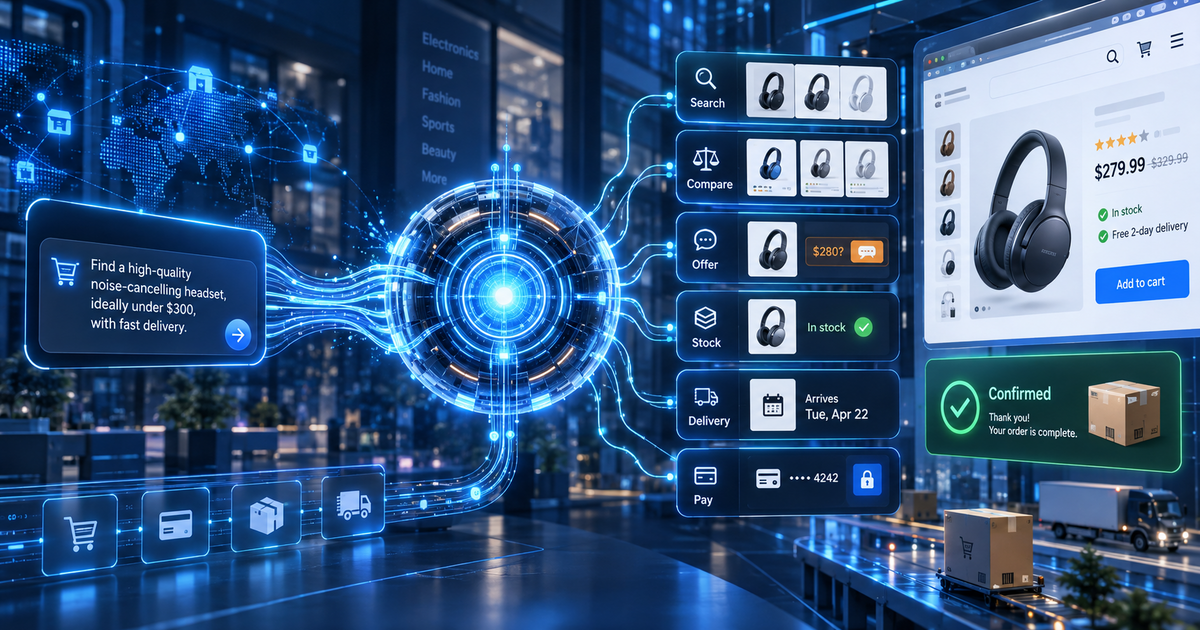
For most of ecommerce's history, "the customer" has meant a person on a screen: searching, scrolling, comparing tabs, adding to cart. That assumption is starting to break. Increasingly, the entity doing the searching, comparing, and buying is an AI agent, acting on a person's behalf.
This is what the industry now calls agentic commerce (or agentic shopping): AI assistants like ChatGPT, Gemini, and Perplexity, or purpose-built shopping agents, that discover products, compare options, and in some cases complete the purchase, with little to no manual clicking from the human they're shopping for.
It's easy to dismiss this as another AI buzzword. The data says otherwise. Here's where agentic shopping actually stands today, where it's headed, what's fueling that growth, and, most importantly, what a business's tech stack needs to look like to actually benefit from it rather than get left behind by it.
Where agentic shopping stands today
It's still early, but it's no longer experimental.
• AI-driven traffic to US retail sites grew 393% year-over-year in Q1 2026, following an 805% spike during Black Friday 2025.
• ChatGPT alone is fielding roughly 50 million shopping-related queries a day.
• AI touched 20% of all Cyber Week 2025 orders, and US agentic-AI-driven orders reached roughly $13.5 billion, about 17% of the period's volume.
• Retailers who had integrated AI shopping agents saw sales grow nearly 7x faster than those who hadn't over the same holiday period.
• Traffic referred by AI agents is converting meaningfully better than traditional channels. Industry data puts AI-referred conversion at around 42% higher than traditional search, and some reports show AI-referred shoppers completing purchases at a much higher rate than social-referred traffic.
At the same time, trust is still catching up to capability. Industry surveys put the share of consumers comfortable letting an agent complete a purchase fully autonomously at around 4% as of early 2026; most people still want a checkpoint before money moves. And on the merchant side, readiness is lagging demand: one UK survey found that while more than half of online merchants believe agents are already active on their platforms, only about 3% of transactions today actually involve one, and just 15% of top retailers say their payment systems are agent-ready.
In short: the traffic and the conversion upside are already real and measurable. The infrastructure to reliably serve and transact with agents is the part most businesses haven't built yet.
How it's expected to grow
Nearly every major analyst firm has now put a number on agentic commerce, and while the estimates vary (because they're measuring slightly different things), they all point the same direction:
• McKinsey projects agentic commerce could generate $3-5 trillion globally by 2030.
• Bain forecasts the US agentic commerce market alone will reach $300-500 billion by 2030, roughly 15-25% of total US ecommerce.
• Gartner expects 20% of digital commerce transactions to run through AI platforms, either on-platform checkout or agent-mediated, by 2030.
• Morgan Stanley projects 10-20% of US ecommerce sales will be agent-driven by the same year, with J.P. Morgan estimating up to 25% of US online sales, concentrated heavily in recurring, low-risk categories like groceries and replenishment.
• The broader agentic AI market in retail and ecommerce is estimated at roughly $60 billion in 2026, growing to over $218 billion by 2031, a compound annual growth rate near 29%.
The pattern across every estimate: this shifts from a low-single-digit share of transactions today to somewhere between one-fifth and one-quarter of all online commerce within the next four years. That's not a niche experiment maturing slowly. That's a structural shift on a genuinely short runway.
What's fueling the growth
A few forces are converging at once, which is why this is moving faster than most prior platform shifts in commerce.
1. The big AI platforms are building checkout directly in. ChatGPT, Gemini, and Perplexity are no longer just answering shopping questions; they're increasingly closing the loop, letting a user go from "what should I buy" to "bought" without leaving the chat. When the interface where people already start their research also lets them finish the purchase, the funnel compresses dramatically.
2. Payment networks have stopped watching and started building. Visa and Mastercard have both moved from pilots to live agent-initiated transactions in 2026, creating "card-like" secure tokens that let an AI agent transact within existing card-network rails, meaning agent purchases can carry the same fraud protection and chargeback safeguards consumers already expect.
3. A shared protocol layer is emerging. A cluster of new standards, including the Agentic Commerce Protocol (ACP) from OpenAI and Stripe, Google's Universal Commerce Protocol (UCP), the Agent Payments Protocol (AP2) backed by Google, Mastercard, PayPal, and others, and network-specific layers like Visa's Trusted Agent Protocol, are starting to standardize how an agent discovers a product, builds a cart, proves it has real authorization from a human, and completes a transaction. These protocols mostly stack on top of each other rather than compete head-on, and adoption is accelerating fast, with major ecommerce platforms already making millions of merchants reachable for AI agent checkout.
4. Recurring and low-consideration purchases are the natural first movers. Replenishment categories, such as groceries, consumables, spare parts, and repeat B2B orders, map almost perfectly onto what agents are good at: comparing known SKUs against price and availability, with minimal need for the kind of exploratory browsing a human still does for a first-time, high-consideration purchase. This is also why B2B procurement, which already runs on structured specs, contracts, and repeat ordering, is positioned to adopt agentic buying just as fast as, if not faster than, consumer retail.
5. Consumer habits are already shifting from search to conversation. The behavior that used to start with a search engine increasingly starts with a prompt. As that habit compounds, the businesses whose data an agent can actually read and trust are the ones that get recommended, and the ones it can't parse become invisible, regardless of how good the product actually is.
What kind of platform is suitable for this shift
This is the part most businesses are underestimating. Being "agent-ready" isn't a marketing checkbox or a plugin you bolt onto an existing setup; it's a stack requirement, and most ecommerce infrastructure built over the last decade wasn't designed for it.
Here's what actually matters:
A single, real-time source of truth. An agent checking stock, price, and eligibility needs one consistent answer, instantly, not five systems that might disagree with each other depending on when they last synced. Platforms built as a patchwork of a CMS, a separate CDP, a separate inventory tool, and a separate ERP will keep serving agents (and customers) inconsistent answers, which erodes exactly the trust this whole shift depends on.
One clean API surface, not a dozen fragmented ones. Every new protocol, ACP, UCP, AP2, is fundamentally an API-level integration. A platform built API-first, on microservices rather than monolithic or heavily plug-in-dependent architecture, can adopt these standards as they mature. A stack stitched together from disconnected point tools has to solve that integration problem separately for every single tool, every single time a protocol updates.
Structured, machine-readable product and content data. Agents don't browse the way humans do; they parse. Catalog data, pricing, availability, and content need to be clean and consistently structured across every module, not scattered across inconsistently formatted pages built for human eyes.
Real intelligence behind the data, not just a feed. A static product feed tells an agent what exists. A platform with an actual intelligence layer, one that understands buying intent and customer context, not just SKUs, can shape what an agent recommends, not just what it's able to find. This is the difference between being included in an agent's answer and being the answer an agent gives.
Fulfillment that executes without manual reconciliation. An order placed by an agent is only a win if it actually ships correctly. That requires inventory, order management, and fulfillment to be part of the same connected system as the storefront and catalog, not a separate process someone has to manually true up afterward.
Governance built for machine access, not just human logins. As payment networks and protocols formalize how an agent proves it's authorized to transact, platforms need a clean, single permission model to expose data and checkout safely to agents, something far harder to secure consistently across a dozen bolted-together vendor tools than across one integrated system.
The takeaway
Agentic shopping isn't a future trend to keep an eye on; it's already showing up in traffic numbers, conversion rates, and holiday sales data. What's still being decided is which businesses will actually be positioned to benefit from it. That won't be determined by who has the most AI initiatives running. It will be determined by whose underlying commerce stack was built to give an AI agent, and the human it's shopping for, one fast, accurate, trustworthy answer every time.
That's precisely the architecture problem Commerzio was built to solve: a single integrated platform, not a stitched-together stack, so that whether the customer at the other end is a person or an agent acting for one, the data, the intelligence, and the fulfillment all come from the same source of truth.
Sources: McKinsey, Bain, Gartner, Morgan Stanley, J.P. Morgan, Mordor Intelligence, and public agentic commerce protocol documentation (2026).