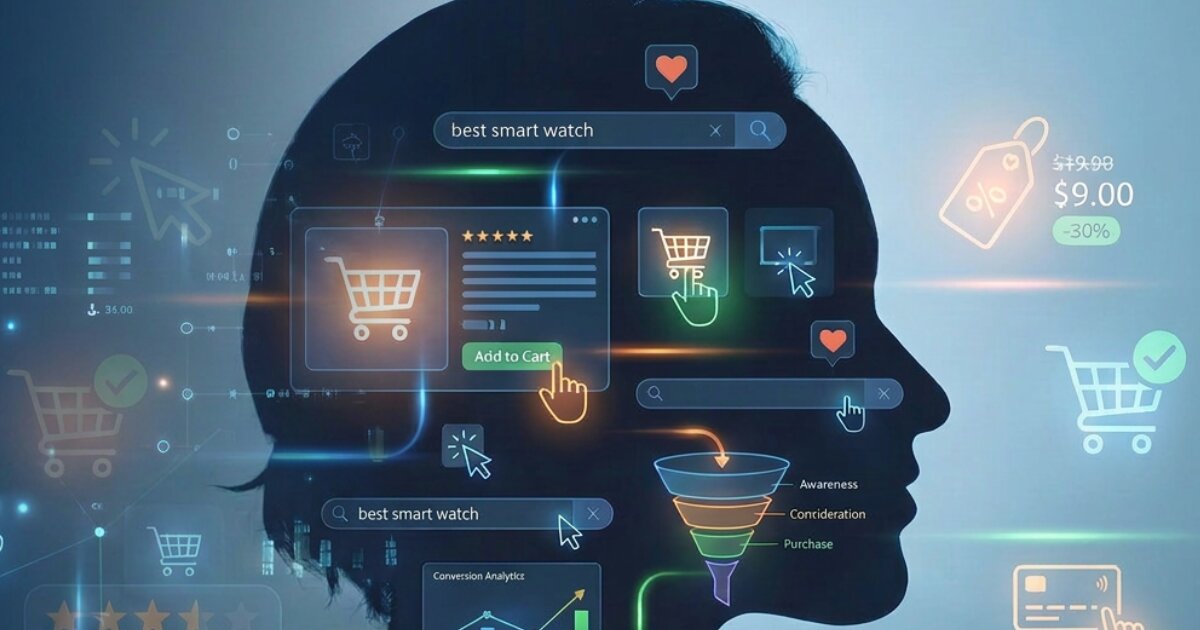
The era we are leaving behind
Walk into any D2C planning meeting in 2026, and you will hear the same numbers you heard in 2022. Sessions. Bounce rate. Add-to-cart rate. Checkout completion. Cart abandonment. AOV. ROAS.
These are the numbers a storefront produces. They are also the numbers a storefront cares about. For ten years, the entire commerce industry — Shopify, Magento, BigCommerce, WooCommerce, every theme shop and Klaviyo agency — has built its product, its content, and its career around making these numbers go up by a few percent at the margin.
And it worked, for a while. When Meta CPMs were ₹40 and Google clicks were ₹8, you could spray traffic at a storefront, optimise the funnel by half a point a quarter, and ride the curve. The platform's job was to not break. The growth came from outside.
That world is gone. Meta CPMs in performance categories have doubled in three years. Google's organic real estate has compressed under AI Overviews. Apple's privacy posture broke retargeting. Every D2C brand we talk to has the same story: they are spending more to get the same visitor, and that visitor is converting at the same rate they did in 2021. The funnel hasn't improved. The cost of feeding it has tripled.
Brands have tried to fix this with tools. A retention tool. A CDP. A personalisation engine. A loyalty plugin. A review widget. A live chat. A heatmap. A second analytics suite to make the first one make sense. A separate WhatsApp tool. By the time most ₹200 Cr D2C brands look up, they are running twelve to fifteen SaaS tools on top of their storefront, paying integration debt every quarter, and still watching their conversion rate flatline.
The mistake is not the tools. The mistake is the question.
The question every storefront platform is built to answer
Open any storefront platform's analytics dashboard and look at what it surfaces first. Sessions today. Conversion rate. Revenue. Top products. Top traffic sources. The shape of the dashboard tells you what the platform thinks matters: how many people came, and how many bought.
This is a traffic question. It treats every visitor as a unit of throughput. It assumes that if you push enough sessions through a clean enough funnel, some predictable percentage will convert. This was never quite right, but it was close enough to be useful — when traffic was cheap.
The traffic question produces traffic answers. Optimise page speed. Run a sale. Test a hero image. Add a sticky CTA. Tweak the checkout. These work, marginally, on the four or five percent of visitors who were already going to buy. They do nothing for the other ninety-five.
And ninety-five percent of your visitors are where the actual revenue lives.
The question we should be asking instead
There is a different question, and it is the only question that matters in 2026: of the people on my site right now, who is actually getting close to buying — and what would it take to close them?
This is not a traffic question. It is an intent question. It treats every visitor as a person on a journey, somewhere between not knowing your brand exists and being ready to put down a credit card. Some of them are five clicks from purchase. Some of them are five months. The platform's job is to know the difference, and act on it.
We call this the intent economy. It is the world that is replacing the storefront economy, and it has different rules.
In the storefront economy, traffic is the input and conversion is the output, and the platform sits in between as a passive pipe. In the intent economy, intent is the input, conversion is the output, and the platform is an active participant — reading signals, scoring readiness, deciding what to do, and doing it across every channel the brand owns.
The platform stops being plumbing. It starts being a brain.
What the storefront generation got wrong about data
The storefront generation believed that if you collected enough data and dumped it in the right CDP, intent would emerge. It does not. We have watched dozens of brands stand up Segment or mParticle, wire fifteen sources into it, build dashboards, and then discover that the data tells them what already happened — and tells them nothing about what is happening now, on this session, with this visitor.
The reason is simple. Intent is not a column in a database. It is a real-time pattern across forty to fifty behavioural signals — scroll depth, hover duration, sequence of pages, repeat visits, search queries, comparison clicks, dwell time on pricing, cart edits, hesitation patterns. These signals are generated continuously and decay quickly. A visitor who shows decision-stage intent at 3:14 p.m. is a different person at 3:18 p.m. The platform that captures the moment captures the customer.
A standalone CDP cannot do this. It is downstream of the storefront, downstream of the email tool, downstream of the analytics suite. By the time it sees the signal, the moment is gone. The brand is making a decision two days later about a customer who has already moved on to a competitor.
This is not a bug in any single tool. It is a structural property of stitched stacks. Intent is a property of the system, not of any one component. If you split the system, you lose the intent.
The 97% problem
Across the brands we have run D2C for — appliances, ayurveda, security, consumer durables — we found the same pattern. Approximately ninety-seven percent of the intent signals a visitor generates in a session are ignored by the platform layer. The platform reacts to one signal: add-to-cart. Everything else is logged, at best, and forgotten.
Ninety-seven percent. That is not an optimisation gap. That is the entire surface area of growth that is sitting unclaimed inside every D2C brand's existing traffic.
Think about what that means. The brand has already paid the acquisition cost. The visitor is already on the site. They are signalling — sometimes loudly — what they need next. And the platform is staring at the front door, watching for somebody to add something to a cart, while ninety-seven percent of the conversation is happening in another room.
Once you see this, you cannot unsee it. The conversion problem is not a traffic problem. It is an intent-capture problem. And no amount of paid spend is going to fix a system that throws away the signal it has already paid to receive.
What the intent economy looks like in practice
An intent-driven platform behaves differently from a storefront. Some examples from our own deployments:
A visitor on an appliance site spends ninety seconds comparing two refrigerator SKUs in the same price band, scrolls back to the higher-priced one twice, and exits without acting. A storefront calls this a bounce. An intent-driven platform reads it as decision-stage hesitation on a specific SKU, scores the session, and triggers a sequence — a recommendation widget on the next visit highlighting the differentiating feature that was hovered over, an email twelve hours later with the comparison summary, a WhatsApp nudge from the dealer nearest the visitor's pincode.
A returning visitor on a wellness site adds three products to the cart, reads two ingredient pages, and leaves before checkout. The storefront sends a generic abandoned-cart email at the four-hour mark. An intent-driven platform recognises that this is the visitor's third decision-stage session this week, prioritises the cart in the recovery queue, sends an ingredient-led email rather than a discount-led one, and elevates the lead to the human follow-up team because the score crossed the conversion threshold.
A first-time visitor on an ayurvedic site arrives from an organic search for a specific symptom, lands on a generic homepage, and bounces in eleven seconds. The storefront tracks this as a failed acquisition. An intent-driven platform reads the search query, the landing page mismatch, and the exit pattern, and the next time a visitor with that intent profile arrives, the platform reorders the homepage grid in real time to surface the right product cluster. The next bounce becomes a session.
None of this is magic. It is what happens when a platform is wired to read intent across forty signals instead of one, and to act on the read across every owned channel — site, email, SMS, WhatsApp, dealer — within the same decision window.
Why this requires a different kind of platform
You cannot retrofit intent capture onto a storefront stack by adding tools. We have watched brands try. The pattern is always the same: every additional tool adds latency, every additional integration adds drift, every additional vendor adds a different definition of what an event is and when it fired. The signal degrades at every hop. By the time the brand has a unified view, the intent moment is hours old.
Reading intent at the speed it is generated requires the storefront, the CDP, the lead engine, the retention engine, the analytics layer, and the AI brain to share one data model and one decision loop. Not integrated — unified. One system, one source of truth, one set of rules about what a high-intent session looks like and what fires when one is detected.
This is what we mean when we say operating system. A storefront is a building. An operating system is the nervous system that runs every floor of the building at the same time, reading what is happening in each room, and deciding which doors to open.
Shopify is a building. A very good building. It is not what the intent economy needs.
The choice every D2C brand will make in the next 18 months
We are not predicting the storefront era will end. We are saying the storefront era has already ended — for any brand whose growth depends on converting more of the traffic it already pays for, rather than buying more of it.
Every D2C brand we know is hitting the same wall. Paid acquisition is up forty to seventy percent. Conversion is flat. The CFO is asking why the SaaS bill keeps growing. The CMO is asking why the ROAS is collapsing. The CTO is tired of explaining why three tools disagree on what a customer is. And the CEO is asking the question that ends storefront careers: where is the next leg of growth coming from?
It is not coming from a new ad creative. It is not coming from a new theme. It is not coming from a new tool. It is coming from the ninety-seven percent of intent signals every brand is currently throwing away.
The choice is whether to keep paying the storefront generation to process traffic — or to move to a platform built to capture intent.
Welcome to the intent economy. We have been building for it for seven years. We finally have a name for what comes next.